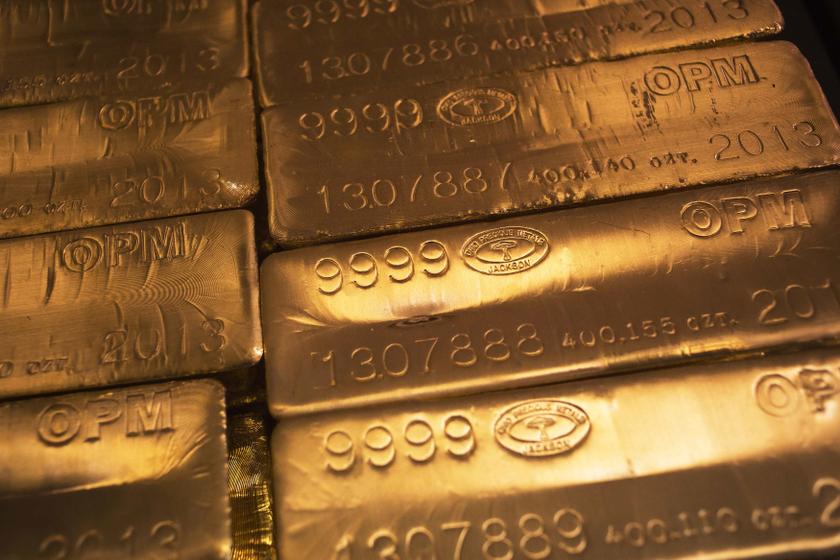
Phillip Futures Sdn Bhd dealer Lee Pei Wan said today’s firmer ringgit had resulted in a higher price for the precious metal on the local front. — Reuters pic
KUALA LUMPUR, Dec 30 — The gold futures contract on Bursa Malaysia Derivatives ended untraded for the third consecutive day today on lack of demand due to a firmer ringgit against the US dollar, said a dealer.
Phillip Futures Sdn Bhd dealer Lee Pei Wan said today’s firmer ringgit had resulted in a higher price for the precious metal on the local front, as it made the ringgit-denominated gold more expensive to international buyers.
“The bullion is the safe-haven asset to hedge against the currency debasement while the coronavirus cases continue to soar globally,” he told Bernama.
At the close, gold futures on Bursa Malaysia for contract months December 2020, January 2021, February 2021, and March 2021 were all unchanged at RM247.50, RM235.60, RM233.60 and RM233.60 per gramme, respectively.
Volume remained nil, while open interest stood at 24 contracts.
At 5 pm today, the price of physical gold was down 95 sen to RM235.55 from RM236.50 per gramme yesterday. — Bernama
The Astra jab—which will be rolled out in Britain from January 4 — can be stored, transported and handled at normal refrigerated conditions. — Reuters pic
LONDON, Dec 30 — Europe’s stock markets mostly rose today after Britain became the first nation to approve a cheap coronavirus vaccine developed by UK pharmaceuticals giant AstraZeneca and Oxford University, eclipsing news of mounting infections and fears of tighter restrictions.
The Astra jab—which will be rolled out in Britain from January 4 — can be stored, transported and handled at normal refrigerated conditions.
It is therefore cheaper and easier to administer than the rival Pfizer/BioNTech and Moderna vaccines which require freezing, and has sparked renewed hope of a return to normality in 2021.
Around midday, London stocks gained 0.2 per cent with sentiment also lifted after European Union leaders signed their post-Brexit trade deal with Britain—with just one day to until the UK finally leaves the bloc.
In the eurozone, Paris stocks edged up 0.1 per cent while Frankfurt flatlined after this week’s record-breaking run as Germany mulled extending its virus lockdown in the face of rising cases and deaths.
Asia was also mostly firmer with vaccine and economic recovery optimism helping investors look past an alarming surge in Covid-19 cases around the world.
Worst behind us?
“Today’s vaccine news is helping European stocks,” AvaTrade analyst Naeem Aslam told AFP.
“It will not be a stretch ... to say that the worst may be behind us and things are likely to improve going in 2021.”
London’s FTSE 100 benchmark index surged 1.6 per cent on Tuesday, its first trading day since Prime Minister Boris Johnson unveiled the long-awaited Brexit agreement late on Christmas Eve.
“We expect global economic recovery to shift into a higher gear in 2021 and that means more gains for European markets,” added Aslam.
“In addition to this, the Brexit trade deal is highly likely to provide massive tailwind for UK and European stocks.”
In foreign exchange activity, the US dollar languished around 2.5-year lows versus the euro and pound, as investor appetite grew for riskier assets like equities.
Bitcoin, the world’s most popular cyber currency, extended his month’s blistering run to strike another record high at US$28,572.10 (RM115,346).
Pharma propels stocks
Back in London, today’s announcement sent AstraZeneca shares racing 0.9 per cent higher to 7,530 pence.
However, the stock remains about 1.0 per cent down over the course of this year despite development of the group’s landmark vaccine.
Drugs rival GlaxoSmithKline shares rose by 0.5 per cent but has shed almost a quarter in value since the start of 2020.
“The pharmaceuticals and biotech sector is down nearly 10 per cent for the year,” AJ Bell investment director Russ Mould told AFP.
“This seems like rank ingratitude given the importance of the vaccines upon which they are working, with the AstraZeneca-University of Oxford product due for roll-out any day now—and GlaxoSmithKline hopeful of launching a product in late 2021.
“Yet through their very success, the drug firms are helping to promote the share prices of others—companies which will benefit much more dramatically from any success in the effort to contain and beat back the virus and permit any degree of return to economic normality.”
The UK government has ordered 100 million doses of the Astra jab, with 40 million scheduled to be available by the end of March.
Britain approved a shot produced by Pfizer-BioNTech on December 2, and has already vaccinated around 800,000 people with the first dose.
The upbeat Astra news comes as a mutated strain of the disease—which spreads more quickly but is no more deadly—has been detected in several countries. That has put severe pressure on governments to impose stricter containment measures.
Wall Street had dipped Tuesday on disappointment that Republicans had blocked a move to ramp up stimulus cash handouts, though US lawmakers will likely push ahead with more support measures after Joe Biden takes over at the White House. — AFP
At 6pm, the local currency improved 130 basis points (bps) to 4.0350/0390 against the greenback from yesterday’s close of 4.0480/0510. — AFP pic
KUALA LUMPUR, Dec 30 — The ringgit settled higher versus the US dollar today, rebounding from yesterday’s losses on renewed demand and in line with the steadier in crude oil prices, an analyst said.
At 6pm, the local currency improved 130 basis points (bps) to 4.0350/0390 against the greenback from yesterday’s close of 4.0480/0510.
Axi chief global market strategist Stephen Innes said with the vaccines on their way, it would brighten the prospects for the global economy whereby emerging markets and their respective currencies would be the huge beneficiaries into 2021.
“Today oil prices remain supported on vaccine optimism, which boosted market sentiment for emerging currencies including the local currency,” he told Bernama.
At the time of writing, the benchmark Brent crude rose 0.8 per cent to US$51.50 (RM208) per barrel.
Meanwhile, the ringgit was traded mixed other major currencies.
It improved against the Singapore dollar to 3.0441/0481 from 3.0484/0509 on Wednesday and appreciated versus the euro to 4.9497/9559 from 4.9584/9625 yesterday.
The local note, however, fell versus the Japanese yen to 3.9084/9126 from 3.9039/9080 and dropped against the British pound to 5.4775/4846 from 5.4527/4587 previously. — Bernama
The SC cautioned the public against dealing with unlicensed investment advisers as they could be defrauded. — Picture from Twitter/SCMalaysia
KUALA LUMPUR, Dec 30 — The Securities Commission Malaysia (SC) today issued a guidance note to provide clarity to the industry and the public on conduct which it would consider as falling within the regulated activity of providing investment advice under the Capital Markets and Services Act 2007 (CMSA).
“(The note) is issued in response to the increasing number of queries and complaints received regarding various social media, chat rooms and messaging applications that appear to be providing specific stock recommendations and/or investment advice to members of the public, who are given access to these recommendations and/or advice upon payment of a fee,” the regulator said in a statement today.
The SC cautioned the public against dealing with unlicensed investment advisers as they could be defrauded or used as part of a market manipulation scheme.
Investors were reminded to verify the licensing status of platforms, companies and individuals offering capital market services or products, including the provision of investment advice, before making any investment decision.
It added that any person carrying on a business of giving investment advice without a license commits an offence under the CMSA which is punishable with a fine not exceeding RM10 million or imprisonment not exceeding 10 years or both, if found guilty.
“Members of the public who have any information on any person providing investment advice without a licence may contact the SC’s Consumers and Investors Department at 03-6204 8999 or email aduan@seccom.com.my,” it said. — Bernama
The FTSE Bursa Malaysia KLCI saw its steepest fall in March. — Bernama pic
KUALA LUMPUR, Dec 30 — A decade low to stunning recovery and some bumpy rides in between, Malaysia’s equities market saw it all in the year that was filled with unprecedented challenges.
When the Covid-19 pandemic first shook China in February, analysts had placed an outlook that the virus outbreak would put economies under pressure and worst hit the local market one month later.
The benchmark index, the FTSE Bursa Malaysia KLCI (FBM KLCI) recorded its steepest fall in March, when it slumped to an intraday low of 1,207.80, the lowest mark in 11 years.
This was due to the rapid spread of Covid-19 across the world, wreaking havoc in its wake, with declining oil prices, weak consumer data, and closure of international borders which leaves cyclical stocks especially airlines, automobiles and consumer chains under heavy pressure.
The downturn not only witnessed the sharp contraction in local equities but also global benchmarks such as the US Dow Jones Industrial Average, Singapore’s Straits Times Index, Hong Kong’s Hang Seng Index, Japan’s Nikkei 225, and Asia’s emerging market benchmark, the South Korean KOSPI.
On the local market, the sharp fall had led regulators to implement a freeze on short selling to reduce market volatility as retail participants leapt to record high, driven by the six-month blanket banking moratorium that was given to all Malaysians.
Besides Covid-19, the local political scenario, US Presidential election, inflation, economic outlook, global interest rates, oil and other commodity prices, as well as the global equity performance were the highlights.
However, in every downturn, there is a silver lining.
After the sharp downturn in March, the FBM KLCI had steadily staged a rebound to surpass the 1,690 level before the market heads to a quiet year-end.
This was driven by virus containment success and the decline in unemployment data as the movement restrictions were gradually lifted, as businesses resumed operations and started embracing the new normal.
The 30-stock market bellwether which now stands at RM1.07 trillion in terms of market capitalisation, moved between 1,207.80 to 1,695.96 during the 52 weeks, and recorded an annual return of 4.77 per cent, despite the downturn in March, with a healthy market price-earnings ratio of 23.21 times.
As at December 28, international investors had sold equities worth RM24.6 billion net this year, and as the year-end approaches, foreign investors have turned net buyers during the window dressing period, targeting oversold stocks.
From the technical perspective, the index is heading towards a full recovery from before the brouhaha due to the US-China trade tensions that led to a global market slide in 2019.
On the overall market, the healthcare index, on a year-to-date performance, increased more than 200 per cent to become the best performing index for the year.
Glove counters, namely Top Glove Corp Bhd, Hartalega Holdings Bhd, Supermax Corp Bhd, and Kossan Rubber Industries Bhd, all recorded more than 400 per cent surge in their share prices, mainly attributed to the high demand for gloves.
Besides healthcare, technology stocks have also seen an upside as Covid-19 pushed digitisation and digitalisation efforts on every front, from individuals to businesses as they embrace the new norm.
The technology index saw a 100 per cent surge from the start of the year till date, and the uptrend is expected to continue at a steady pace.
While the healthcare and technology sectors continue to record gains, the energy index has been under pressure until air travel returns to normal.
The index, which dipped about 30 per cent this year, will continue to be volatile at least until the end of the first quarter of next year, with an upward momentum.
As of today, the Brent crude oil price is hovering at US$51 (US$1 = RM4.04) per barrel and is heading towards a recovery towards the level recorded on Jan 1 this year at US$62 per barrel.
With the bullish uptrend in place, an economic recovery is on the horizon with mass vaccination against Covid-19 taking place globally. Analysts are hoping that the dark clouds that have been cast on the global economy will soon pass.
The Finance Ministry, in its 2021 economic outlook, has forecast that Malaysia’s gross domestic product will expand between 6.5 per cent and 7.5 per cent in 2021 after a contraction of 4.5 per cent this year.
“However, this could hinge on two major factors—successful containment of Covid-19 and recovery of external demand,” said the report.
Analysts meanwhile remain cautious on the outlook especially in the first quarter of 2021 as Malaysia is facing challenges in managing its hospital capacity in treating the Covid-19 cases.
“The process of containment plays a vital role for now especially in attracting foreign inflows. Besides that, political stability is also crucial in retaining confidence.
“This is in line with expectations that the 15th General Election might be called once Covid-19 is under control which is expected to be in the second quarter of 2021,” an analyst told Bernama.
She added that the current overbought position on certain index linked stocks will be corrected once short selling is lifted come Jan 1.
“Once the technical correction takes place, the index could reach an upside of 1,740 next year, barring any unforeseen circumstances,” she said.
Meanwhile, Public Investment Bank said the market remains relatively undervalued from a risk-reward perspective, considering the record-low interest rate environment.
“We believe the fervour should continue going into the first half of 2021. There are potential speed bumps along the way, the decisive one being foreign capital flight as a result of sovereign rating downgrades, though this possibility remains remote for now.”
The market remains a trading-oriented one amid the ongoing Covid19 pandemic which may rage on well into late-2021 despite the number of vaccines coming on-stream.
Hence, the investment bank’s end-2021 FBM KLCI target is at 1,750 points. — Bernama
KUALA LUMPUR, Dec 30 — UEM Sunrise Bhd’s wholly-owned subsidiaries, UEM Land Bhd and Nusajaya Heights Sdn Bhd, is proposing to dispose of 72 of the companies’ freehold industrial plots in Johor Bahru to AME Elite Consortium Bhd’s units, Pentagon Land Sdn Bhd and Greenhill SILC Sdn Bhd for RM434.3 million.
In a filing with Bursa Malaysia today, UEM said the parties had entered into several definitive agreements on the sale of the industrial plots, measuring approximately 68.7 hectares, which are located in Phase 3 of the Southern Industrial and Logistics Clusters (SiLC) in Johor Bahru.
In a separate statement, UEM Sunrise’s Performance Delivery and Commercial chief officer Anuar Kasim said the sale marks the start of a strategic collaboration between UEM Sunrise — the landowner and master developer of Iskandar Puteri—and AME Elite Consortium, a specialist in the construction of customised large manufacturing plants and design-and-build and development of industrial parks.
“We are confident that this collaboration with AME Elite Consortium will be another catalyst for the Iskandar Puteri Development Masterplan, particularly in accelerating the growth and development of SiLC.
“This will have a positive impact on the rapidly growing township of Iskandar Puteri, enhancing its livable qualities for the surrounding communities,” he said.
He said the sale is expected to steadily contribute to UEM Sunrise group’s earnings over the next three to four years, with proceeds to be channelled towards the company’s strategic initiatives, including new land banking opportunities.
Anuar said with Phases 1 and 2 of the SiLC sold out, the collaboration with AME Elite Consortium would enable the roll-out of Phase 3 more rapidly as UEM Sunrise would be dealing with an industrial park specialist rather than several plot buyers.
He added that AME Elite Consortium has given its commitment via the definitive agreements to acquire the entire balance of the industrial plots in SiLC Phase 3.
Meanwhile, AME Elite Consortium managing director Kelvin Lee Chai said the company aims to generate more than RM1.5 billion in gross development value (GDV) through the land acquisitions.
He said with the new lands, its total landbank would increase to 93.9 hectares, allowing them to generate sizeable GDV over the development period.
“The enlarged scale of developments would extend the sustainability of our earnings even further,” said Lee.
AME is currently developing two integrated industrial parks in Johor—i-Park@Indahpura (Phase 3) and i-Park@Senai Airport City (Phase 1, 2 and 3). — Bernama
JAKARTA: Indonesia and a unit of South Korean firm LG Group have signed a memorandum of understanding (MOU) on a $9.8 billion electric vehicle (EV) battery investment deal, the head of Indonesia's Investment Coordinating Board said on Wednesday.
The deal was signed on Dec. 18 and includes investments across the EV supply chain, the board head, Bahlil Lahadalia, told a news conference.
An official at LG Energy Solution, a unit of LG Group, South Korea's fourth-largest conglomerate, confirmed it had agreed an MOU but could not provide details or the deal's value. LG Group in Seoul referred Reuters to its affiliate.
Bahlil said the agreement made Indonesia the first country in the world to integrate the electric battery industry from mining to producing electric car lithium batteries.
"We have signed an MOU for the construction of an integrated electric battery factory from upstream to downstream," Bahlil said.
"Mines, smelters, precursors, cathodes, cars to recycling facilities will be built in Indonesia," he said, adding that the project will be located in North Maluku and Central Java.
Under the MOU, at least 70% of the nickel ore used to produce the EV batteries must be processed in Indonesia, he said.
Indonesia aims to start processing its rich supplies of nickel laterite ore for use in lithium batteries as part of a bid to eventually become a global hub for producing and exporting EVs.
Indonesia said earlier this month that U.S. automaker Tesla , will send delegations to Indonesia in January to discuss potential investment in a supply chain for its electric vehicles. - Reuters
TOKYO: Asian shares hit a record high on Wednesday with investors betting on a strong economic recovery next year, as there is little sign policymakers wind back massive stimulus efforts aimed at staving off coronavirus-fuelled downturns.
MSCI's gauge of Asia-Pacific shares excluding Japan rose 1.2% to hit a record high, led by gains in Chinese shares and bringing its gains so far this year to 18.9%.
Japan's Nikkei share average lost 0.45% on its last trading day of 2020 after jumping to a 30-year high on Tuesday. For the year, it was up 16.0%.
European shares are seen dipping slightly with Euro Stoxx 50 futures down 0.2% and FTSE futures losing 0.1%.
Convictions that global monetary authorities will continue to pump liquidity into the banking system to support the pandemic-stricken economy underpin risk assets.
"We think continued monetary and fiscal policy support means investors should take risk. Stocks will do better than bonds. Within bonds, corporate bonds should beat government bonds," said Hiroshi Yokotani, head of Asia-Pacific fixed-income business at State Street Global Advisors.
E-Mini futures for the S&P 500 rose 0.41%, erasing losses made in the previous day after U.S. Senate Majority Leader Mitch McConnell put off a vote on President Donald Trump's call to boost COVID-19 relief checks.
Although many Republican Senators remain adamantly opposed, worried about the cost to taxpayers, support is growing among them, including two from Georgia, who are running in the crucial races that will determine who will control the Senate.
END OF ILLUSION?
Even an alarming spread of a COVID-19 variant in many countries has so far done little to curb investors' appetite.
The United States has detected its first-known case of the highly infectious coronavirus strain already spotted in Britain and South Africa.
But a crack may be appearing in market euphoria, said Yasuo Sakuma, chief investment officer at Libra Investments, noting some red-hot U.S. small cap shares, such as biotech and software-as-a-service stocks, have failed to catch up with a broader rally.
"There are lots of loss-making companies that are valued at more than $10 billion. I think the time is up for the illusion that they can make money by doing business only in a virtual world. Soon these firms could find themselves no longer able to attract money just because they have a nice business idea or some nice test products." he said.
The Russell 2000, a U.S. stock index that includes small cap shares, fell 1.85% on Tuesday.
In the currency market, the dollar dropped on the first day of trading for settlement in 2021 as traders started to dump the safe-haven U.S. currency anew.
The euro rose 0.3% to $1.2295, a level last seen in April 2018.
"The start of COVID-19 immunization campaigns in several countries as well as additional U.S. fiscal support reduce downside risk to the global economy and bode well for general financial market sentiment," analysts at Commonwealth Bank of Australia said in a note.
The Australian dollar rose 0.6% to $0.7663, hitting a 2 1/2-year high, while sterling traded up 0.30% at $1.3556.
The Japanese yen also gained 0.15% to 103.36 per dollar.
The U.S. dollar index losing 0.25% to stand at 89.798, having hit a 2 1/2-year low of 89.711 at one point.
A sluggish dollar supported gold, with bullion prices up 0.14% at $1,880.70 an ounce.
Oil prices extended gains after a rebound overnight as investors hoped that an expanded U.S. pandemic aid stimulus would spur fuel demand and stoke economic growth.
U.S. West Texas Intermediate crude futures were up 0.21% at $48.10 a barrel.
Treasuries were little changed after trading sideways overnight in thin trade amid the year-end holidays. U.S. two-year yields were steady at 0.127% and benchmark 10-year yields stood at 0.9364%. - Reuters
SYDNEY: The Australian and New Zealand dollars rose on Wednesday as their U.S. counterpart remained locked in a downtrend, while investors wagered the widening rollout of vaccines would bolster global growth and commodities next year.
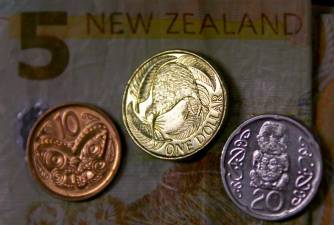
The kiwi dollar climbed to $0.7176, reaching its highest point since April 2018. That was up from a $0.7085 low early in the week and another step toward a major chart target at $0.7395.
The Aussie firmed to $0.7631, again up from a $0.7559 low touched at the start of the week. The next big barriers were the recent 2-1/2 year top of $0.7639 and then $0.7677.
It was also faring well against the Japanese yen, having reached its highest since April 2019 at 78.94 yen.
Part of the gains were due to broad-based weakness in the safe-haven U.S. dollar as the market bets on better times in ahead and more debt-funded U.S. stimulus.
"The start of Covid-19 immunization campaigns in several countries as well as additional U.S. fiscal support reduce downside risk to the global economy and bode well for general financial market sentiment," said Elias Haddad, senior currency strategist at CBA.
The decline in the U.S. dollar is lifting prices for many commodities priced in the currency, supporting earnings from resource exports out of Australia and New Zealand.
Australia's earnings from iron ore alone climbed to a record high of A$139 billion ($105.95 billion) in the year to November, and prices have risen further since then.
One looming threat at home was a growing outbreak of coronavirus in Sydney, with more cases being reported on Wednesday and outside the initial cluster.
The state government announced tighter social restrictions for New Year's Eve but the risk was for a broader lockdown across Australia's biggest city. - Reuters