01 January 2021

All quiet on cross-Channel front as new era opens in Dover

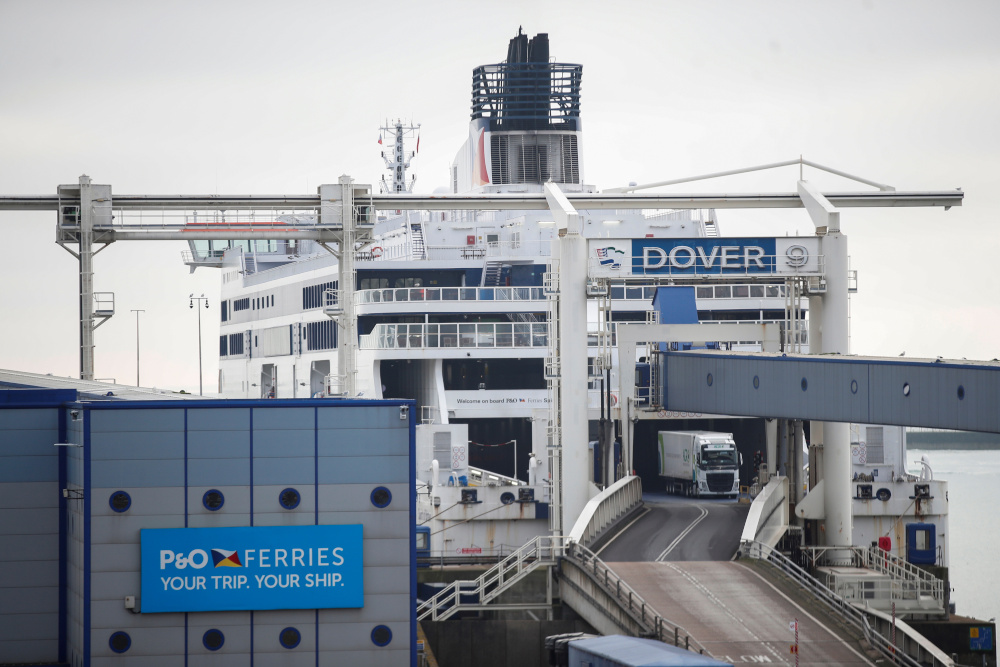
A lorry is seen on board of a ferry at the Port of Dover following the end of the Brexit transition period, Dover January 1, 2021. — Reuters pic

DOVER, Jan 1 — As dawn broke today over Dover, Britain’s trading gateway to the European Union, the first ferry sailings to and from France of a new post-Brexit era left without delay or drama in holiday-thinned traffic.

A small but steady stream of lorries arrived through the morning at the port in southeast England — Europe’s busiest for roll-on, roll-off freight — with new customs processes appearing to work smoothly.

As drivers approached its eastern ferry docks, they were met by police officers checking that they had completed Covid-19 tests, before being waved through if they showed a negative result.

The driver of a red van with Polish number plates was one of very few turned away for not having a test result, and redirected to sites north of the port where rapid testing is being conducted.

“It’s good to see the port’s done its job and there’s no backlog,” Alan Leigh, 52, of nearby Folkestone, told AFP while taking an early New Year’s Day stroll on the cliffs above the docks.

Beneath him P&O’s “Pride of Kent” vessel sailed out of Dover on time at 0750 GMT, as Britain began life outside the EU’s single market and customs union.

“They’ve had plenty of time to prepare,” Leigh said of officials and government departments. “They’re experts — you’ve got to have faith in them.”

A last-ditch trade deal between London and Brussels, signed only on Christmas Eve, has averted the need for tariffs and quotas that could have severely disrupted trade.

Scores of lorries also passed through the Channel Tunnel connecting Folkestone to France by rail early Friday “without any problem”, its operator Getlink said.

“The traffic was strong enough for an exceptional and historic night, everything went well,” a spokesperson for the group told AFP.

But those involved in cross-Channel trade still fear potential trouble in the coming weeks and months, as customs checks and more paperwork for European travel and trade are needed for the first time in decades.

Ferry group Stena Line tweeted that six freight loads bound for EU member Ireland were turned away at the port of Holyhead in north Wales on Friday for not having the correct paperwork.

However, freight traffic is expected to be lower than usual over the coming days after firms scrambled to move extra shipments ahead of the end of an 11-month Brexit transition period at 2300 GMT yesterday.

Today was a public holiday for New Year’s Day in both Britain and France, and officials expect a bigger test to come when cross-Channel traffic starts picking up next week. — AFP


Source: Malay Mail

Smooth start in France for Channel traffic as Brexit kicks in

Orange and green lanes for entry into France and the EU are seen on the road as new customs infrastructure for Brexit at Eurotunnel terminal in Coquelles, near Calais December 31, 2020. — Reuters pic

CALAIS, Jan 1 — Cross-Channel freight traffic between Britain and France was moving smoothly today in the first hours after London’s exit from the EU customs union, dispelling fears of immediate snarl-ups in the wake of the historic change.

Hundreds of lorries had crossed into France and left the country for the United Kingdom through the Channel Tunnel while dozens more were carried on ferries, with no reports of any major hold-ups. 

Almost 200 lorries passed through the tunnel after Britain formally left the EU customs union and single market at midnight in the final act of its exit from the European Union, operator Getlink said.

The first ferry to set sail for France under the new arrangements, The Pride of Kent of P&O Ferries, meanwhile docked in Calais mid-morning. 

“The traffic was strong enough for an exceptional and historic night, everything went well,” a spokesperson for Getlink told AFP.

“All the trucks completed the formalities” required by the fact Britain is no longer part of the EU customs union. “None of the lorries were sent back,” the spokesperson said.

French officials have insisted that disruption at the frontier in Calais in northern France is being minimised by a so-called “smart border”. Hauliers are required to enter information about their freight online in advance with only a rapid scan needed at the border.

Once this is done the trucks can either be waved through with a green light or subjected to extra checks if given an orange one.

Officials also say that British businesses have also stockpiled for January, which is also a relatively quiet month with little activity after Christmas.

The first vehicle to pass through heading for Britain was a heavy goods vehicle from Romania carrying post and parcels, which was symbolically given the go-ahead by Calais mayor Natacha Bouchart.

“I am very happy, it is a privilege for me,” said its driver Toma Moise, 62.

Bouchart, who pressed the button allowing the lorry to leave, said it was a “historic moment” adding that going back to customs checks after the UK’s near half century of EU membership “will have consequences whose range we don’t yet know”.

‘Don’t fear Brexit’

There had been immense bottlenecks of traffic after France briefly closed the border in late December when a new coronavirus variant was found in Britain. 

But with all drivers coming in now taking tests before entering France, the backlog was cleared just in time for the completion of Brexit.

The first to submit to a check on entering France was a lorry driven by Ukrainian Viktor who smiled and noted that “colleagues from England said ‘congratulations’ to me, because I’m the first driver”.

Of the 36 trucks disembarking from the Pride of Kent, which left from the British port of Dover, three were told to stop for additional checks, the AFP correspondent said.

Calais port president Jean-Marc Puissesseau said Thursday that officials were relaxed about the new arrangements after carrying out dry runs and investing €13 million (RM62.7 million).

“We regret Brexit, but we don’t fear it... We are at ease because for three years now we have been able to perfect everything we’ve prepared,” Puissesseau said.

Some 70 per cent of trade between Britain and the EU passes through the French ports of Calais and Dunkirk. On average, 60,000 passengers and 12,000 trucks pass through daily. — AFP


Source: Malay Mail

First ferry docks in France after Britain exits single market

The Pride of Kent, a ferry of the trans-Channel ferry company P&O, arrives at the Port of Dover, amid the coronavirus disease (Covid-19) outbreak, in Dover December 24, 2020. — Reuters pic

CALAIS, Jan 1 — The first ferry from Britain bound for Calais after the UK’s exit from the EU customs union docked in the northern French port today, with three dozen vehicles disembarking in a smooth operation, an AFP correspondent said.

The Pride of Kent of P&O Ferries docked in Calais at 0915 GMT, hours after Britain left the customs union and single market in the final act of Brexit.

There had been no ferries earlier in the day due to the New Year.

Under the rules of the so-called “smart border” implemented by French authorities to minimise queues, hauliers send information on their freight in advance with disembarking traffic either waved through or told to stop for further checks.

Of the 36 trucks disembarking from the Pride of Kent, which left from the British port of Dover, three were told to stop for additional checks, the AFP correspondent said.

Calais port president Jean-Marc Puissesseau said yesterday that officials were relaxed about the new arrangements after carrying out dry runs and investing €13 million (RM62.7 million).

Some 70 per cent of trade between Britain and the EU passes through the French ports of Calais and Dunkirk. On average, 60,000 passengers and 12,000 trucks pass through daily. — AFP


Source: Malay Mail

New Year, new rules: UK begins post-Brexit future

Flags of the Union Jack and European Union are seen ahead of the meeting of European Commission President Ursula von der Leyen and British Prime Minister Boris Johnson, in Brussels, Belgium December 9, 2020. — Reuters pic

LONDON, Jan 1 — Britain today began a new year and life outside Europe, after leaving the bloc’s single market trading rules to go it alone for the first time in nearly half a century.

Brexit, which has dominated politics on both sides of the Channel since 2016, became reality an hour before midnight, ending the UK’s 48-year obligation to follow Brussels’ rules.

Free movement of over 500 million people between Britain and the 27 EU states ended.

More rigorous customs checks returned for the first time in decades, despite the hard-fought brokering of a tariff- and quota-free trade deal.

New Year’s Day newspapers reflected the historic but still deeply divisive change, which will have repercussions for generations to come.

The pro-Brexit Daily Express’ front-page photograph showed the White Cliffs of Dover — an enduring symbol of Britishness — with “Freedom” written on a Union flag.

“Our Future. Our Britain. Our Destiny,” said the headline.

The pro-EU Independent was less sure: “Off the hook — or cut adrift?” it asked, reflecting widespread uncertainty at the path the country had now chosen.

As dawn broke on 2021, attention turned to Britain’s borders, particularly the key Channel seaports, to see if the end to seamless trade and travel would cause delays and disruption.

But with New Year’s Day a public holiday followed by a weekend, and the government having announced the phased introduction of checks, few immediate problems were envisaged.

“The traffic forecast for the next few days is very light,” said John Keefe, spokesman for Eurotunnel, which transports freight, cars and coaches under the Channel.

Practical changes

As the first ferry left the port of Dover early Friday, truckers rolling into Calais had to deal for the first time with the new rules for transporting goods to and from mainland Europe.

The Road Haulage Association, an industry body, estimates that some 220 million new forms will now need to be filled in every year to allow trade to flow with EU countries, including permits to even drive on the roads leading to ports like Dover.

“This is a revolutionary change,” Rod McKenzie, managing director of public policy at the RHA, told The Times newspaper this week. 

Other practical changes include how long Britons can visit their holiday homes on the continent, to travel with pets, and an end to British involvement in an EU student programme.

Holidaymakers and business travellers used to seamless EU travel could face delays, although fears Britons will have to get international permits to drive in Europe were averted by a separate accord.

British fishermen are disgruntled at a compromise in the free trade agreement to allow continued access for EU boats in British waters, which has raised fears of clashes at sea.

The key financial services sector also faces an anxious wait to learn on what basis it can keep dealing with Europe, after being largely omitted from the trade deal along with services in general, which account for 80 per cent of Britain’s economy.

In Northern Ireland, the border with Ireland will be closely watched to ensure movement is unrestricted — key to a 1998 peace deal that ended 30 years of violence over British rule.

And in pro-EU Scotland, First Minister Nicola Sturgeon gave a clear sign of a looming battle ahead for a new vote on independence.

“Scotland will be back soon, Europe. Keep the light on,” she tweeted.

‘Make the most of it’

Despite the uncertainty, Prime Minister Boris Johnson is bullishly optimistic, writing in Friday’s Daily Telegraph that Brexit presented “opportunities unknown to modern memory.

He said Britain had been given “a safe European home” since joining the then Common Market in 1973, but added that “the world has changed out of all recognition, and so has the UK.

“We need to keep pace with developments on the west coast of America and in the Pearl River delta,” he added.

“We need the Brexit-given chance to turbo-charge those sectors in which we excel.” 

Divisions over Brexit, both political and social, remain deep and are likely to last for years, despite a muted end to the saga overshadowed by the global health crisis.

Opinion polls indicate that most Britons want to move on and are far more worried about the worsening coronavirus pandemic, which has left more than 73,500 dead in Britain alone.

Johnson, who survived several days in intensive care with Covid last April, warned of tough times ahead but said a UK-developed vaccine offered grounds for hope.

But his desire for a prosperous, more globally focused Britain could yet see a resurgence of Brexit wrangling, as the country finds out what its new trading terms mean in reality. — AFP


Source: Malay Mail

Perodua beats 2020 sales target with 220,154 units sold, upbeat on 2021 outlook

Perodua launched the 2020 Bezza in Kuala Lumpur in this file picture taken on January 8, 2019. — Bernama pic

KUALA LUMPUR, Jan 1 — Perodua registered sales of 220,154 vehicles in the whole of 2020, beating its 210,000-unit target on the back of strong demand for its vehicles as consumers took advantage of the government’s sales tax exemption.

President and chief executive officer Datuk Zainal Abidin Ahmad said Perodua manufactured 220,968 vehicles last year despite temporarily halting production between March and May due to the movement control order.

“The tax exemption introduced in June 2020 succeeded in spurring car buyers’ interest that was able to sustain the players as well as the local automotive ecosystem.

“Perodua also hit the one million energy-efficient vehicle (EEV) milestone in November 2020 – exactly two years after achieving the half-million — further solidifying our position as Malaysia’s largest EEV manufacturer,” he said in a statement today.

Zainal said the better-than-expected sales achievement had a direct positive impact on the Malaysian automotive ecosystem, helping both independent parts suppliers and dealers weather the challenges in 2020.

“We look forward to a better year ahead as there are positive indications that the Covid-19 pandemic would be overcome with the recently-released vaccines. We will announce our 2021 targets and updates later,” he said.

He said the company would continue to fulfil outstanding orders and push for higher sales in 2021.

“We wish all Malaysians a safe, healthy and happy 2021. Perodua will never stop improving all aspects of our business to continue to satisfy and surpass all your mobility needs and wants, including continuing to push the fuel-efficiency envelope via advanced technology that will remain affordable,” he added. — Bernama


Source: Malay Mail

Tencent games removed from Huawei app store over revenue dispute, says source

People walk past an office building of Chinese tech firm Tencent, owner of messaging app WeChat, in Beijing, China August 7, 2020. — Reuters pic

BEIJING, Jan 1 — Tencent’s online game offerings have been removed from Huawei’s app store since the two companies failed to reach an agreement on revenue sharing, Tencent and a source said today.

“Due to the failure of Huawei’s mobile game platform to renew its contract with our Mobile Game Promotion Project Agreement as scheduled, relevant products of Tencent Games were suddenly removed from the shelves early this morning,” Tencent said in a statement.

“At present, active communication is being made to try to resume as soon as possible,” it said.

Tencent sells some of the top-ranked online games worldwide, while Huawei has a 41.4 per cent share of the China mobile phone market and 14.9 per cent of the global market, according to data from market research firms IDC and Canalys.

A source said the games were removed because the companies could not agree on a revenue sharing deal for the app store sales. Huawei insists on receiving a 50 per cent cut, the source said.

Huawei did not immediately respond to a request seeking comment. Tencent did not immediately respond to a request seeking comment on whether the firms had disagreed about revenue sharing.

There was already some resistance from games developers to Huawei’s revenue demands. This included Shanghai-based developer Mihoyo, which last year decided not to place its hit game Genshin Impact on Huawei’s app store because it did not agree with the commission structure for sales. — Reuters


Source: Malay Mail

NYSE says starting process to delist three China telco companies

The Fearless Girl statue is seen outside the New York Stock Exchange (NYSE) in New York City, New York, US, June 11, 2020. — Reuters pic

NEW YORK, Jan 1 — The New York Stock Exchange is starting the process of delisting securities of three Chinese telecom companies, China Telecom Corporation Limited, China Mobile Limited and China Unicom (Hong Kong) Limited, it said in a statement yesterday.

The move comes after President Donald Trump in November unveiled an executive order barring US investments in Chinese companies that Washington says are owned or controlled by the Chinese military.

NYSE said that NYSE Regulation reached its decision that the issuers were no longer suitable for listing as the order prohibits any transactions in securities “designed to provide investment exposure to such securities, of any Communist Chinese military company, by any United States person.”

NYSE said that the issuers have a right to a review of the decision. — Reuters


Source: Malay Mail

Drugmakers to hike prices for 2021 as pandemic, political pressure put revenues at risk

Drugmakers including Pfizer Inc plan to raise US prices on more than 300 drugs in the United States on January 1. — Reuters pic

NEW YORK, Jan 1 — Drugmakers including Pfizer Inc, Sanofi SA, and GlaxoSmithKline Plc plan to raise US prices on more than 300 drugs in the United States on January 1, according to drugmakers and data analysed by healthcare research firm 3 Axis Advisors.

The hikes come as drugmakers are reeling from effects of the Covid-19 pandemic, which has reduced doctor visits and demand for some drugs. They are also fighting new drug price cutting rules from the Trump administration, which would reduce the industry’s profitability.

The companies kept their price increases at 10 per cent or below, and the largest drug companies to raise prices so far, Pfizer and Sanofi, kept nearly all of their increases 5 per cent or less, 3 Axis said. 3 Axis is a consulting firm that works with pharmacists groups, health plans and foundation on drug pricing and supply chain issues.

GSK did raise prices on two vaccines — shingles vaccine Shingrix and diphtheria, tetanus and pertussis vaccine Pediarix — by 7 per cent and 8.6 per cent, respectively, 3 Axis said.

Teva Pharmaceuticals Inc hiked prices on 15 drugs, including Austedo, which treats rare neurological disorders, and asthma steroid Qvar, which together grossed more than US$650 million (RM2.6 billion) in sales in 2019 and saw price hikes of between 5 per cent and 6 per cent. Teva hiked prices for some drugs, including muscle relaxant Amrix and narcolepsy treatment Nuvigil, as much as 9.4 per cent.

More price hikes are expected to be announced today and in early January.

In 2020, drugmakers raised prices on more than 860 drugs by around 5 per cent, on average, according to 3 Axis. Drug price increases have slowed substantially since 2015, both in terms of the size of the hikes and the number of drugs affected.

The increases come as pharmaceutical companies like Pfizer are playing hero by developing vaccines for Covid-19 in record time. The hikes could help make up for lost revenue as doctors’ visits and new prescriptions plummeted during the global lockdown.

Pfizer plans to raise prices on more than 60 drugs by between 0.5  per cent and 5 per cent. Those include roughly 5 per cent increases on some of its top sellers like rheumatoid arthritis treatment Xeljanz and cancer drugs Ibrance and Inlyta.

Pfizer said it had adjusted the list prices of its drugs by around 1.3 per cent across all products in its portfolio, in line with inflation.

“This modest increase is necessary to support investments that allow us to continue to discover new medicines and deliver those breakthroughs to the patients who need them,” spokeswoman Amy Rose said in a statement, pointing in particular to the Covid-19 vaccine the company developed with Germany’s BioNTech SE.

It said that its net prices, which back out rebates to pharmacy benefit managers and other discounts, have actually fallen for the last three years.

France’s Sanofi plans to increase prices on a number of vaccines 5 per cent or less and will announce more price increases later in January, spokesperson Ashleigh Koss said.

None of the company’s price increases will be above the expected growth rate of US health spending of 5.1 per cent, she said.

Slashing US prescription drug prices — which are among the highest in the world — was a focus of US President Donald Trump, after making it a core pledge of his 2016 campaign. He issued several executive orders in late 2020 meant to cut prices, but their impact could be limited by legal challenges and other problems.

A federal judge earlier this month blocked a last-minute Trump administration rule aimed at lowering drug prices that was set to be implemented at the beginning of the year. It was challenged by drug industry groups including PhRMA, the nation’s leading pharmaceutical trade group.

President-elect Biden has also vowed to reduce drug costs and to allow Medicare, a US government health insurance programme, to negotiate drug prices. He has support from Congressional Democrats to pass such legislation, which the Congressional Budget Office has said could cost the industry more than US$300 billion by 2029. — Reuters


Source: Malay Mail

In northern France, first trucks cross new customs border with UK

The first trucks leave Eurotunnel's new customs border in Calais just after midnight, as Britain formally exits the European Union, France January 1, 2021. — Reuters pic

CALAIS, Jan 1 — Moments after Britain completed its divorce with the European Union, the first trucks hauling goods across the new customs border presented their clearance documents to French agents before loading onto a train to pass through the Eurotunnel.

A barcode on Romanian driver Toma Moise’s paperwork was scanned and approved in seconds. “The future, I don’t think it will be difficult,” he said in broken English before continuing his journey towards Britain.

Cast as the dawn of a newly independent “global Britain”, its exit from the world’s biggest trading block means the return of customs formalities on the island nation’s frontier with Europe for the first time in several decades.

Freight flows through the Eurotunnel’s Calais terminal were extremely light in the early hours of the New Year.

British and European businesses have warned of carnage at the border as they learn to navigate a wall of red tape and paperwork that threatens to disrupt the smooth flow of nearly €1 trillion (RM4.88 trillion) in annual trade.

Yann Leriche, chief executive of Getlink which operates the Eurotunnel, told Reuters tweaks to customs procedures might be necessary but that there would be no chaos in the weeks ahead. — Reuters


Source: Malay Mail