30 December 2020

Bursa Malaysia higher at mid-afternoon

Market sentiments are mostly positive as Bursa Malaysia continues to trade higher in the afternoon. — Picture by Razak Ghazali

KUALA LUMPUR, Dec 30 — Bursa Malaysia continued to trade higher in the afternoon with a steady-buying interest in the lower liners.

As at 3.05pm, the benchmark FTSE Bursa Malaysia KLCI (FBM KLCI) rose 4.78 points to 1,639.77.

The overall market breadth skewed towards positive territory with gainers outpacing losers 588 to 494, while 455 counters were unchanged, 591 untraded and 62 others suspended.

Volume stood at 5.55 billion units worth RM2.27 billion.

Other heavyweights, Petronas Chemicals, Top Glove and Hartalega surged 12 sen each to RM7.49, RM6.13 and RM12.06, respectively, while Hong Leong Bank advanced 10 sen to RM18.58, Maybank fell four sen to RM8.54, and Public Bank and TNB declined six sen to RM20.64 and RM10.52, respectively.

Among the actives, Sealink appreciated 4.5 sen to 21.5 sen, Pegasus edged up half-a-sen to three sen, MTouche was one sen to eight sen, Parkson rose two sen to 21.5 sen, while Iris Corp was flat at 43.5 sen and Techna-X shed one sen to 16 sen.

On the index board, the FBM Emas Index increased 29.48 points to 11,836.17, the FBMT 100 Index went up 23.57 points to 11,582.23, the FBM 70 dropped 8.94 points to 15,214.99, the FBM Emas Shariah Index improved 67.29 points to 13,245.83, and the FBM ACE slipped 20.72 points to 10,681.67.

The Industrial Products and Services Index added 1.56 point to 177.61, the Financial Services Index decreased 31.71 points to 15,421.7 and the Plantation Index expanded 29.21 points to 7,423.34. — Bernama


Source: Malay Mail

Malaysia's November produce price index falls 3pc

Department of Statistics Malaysia (DoSM) chief statistician Datuk Seri Dr Mohd Uzir Mahidin speaks during a press conference in Putrajaya August 15, 2019. ― Picture by Yusof Mat Isa

KUALA LUMPUR, Dec 30 — The Producer Price Index (PPI) for local production decreased 3.0 per cent year-on-year (y-o-y) in November 2020, said the Department of Statistics Malaysia (DoSM).

In a statement today, chief statistician Datuk Seri Mohd Uzir Mahidin said the decrease in the overall index was attributed to the slump in mining (-45.8 per cent), electricity & gas supply (-0.2 per cent) and manufacturing (-0.1 per cent).

In contrast, the sectors, which increased during the month, were agriculture, forestry & fishing (21.5 per cent) and water supply (0.9 per cent).

On a monthly basis, Mohd Uzir highlighted the PPI for local production grew 2.0 per cent in November.

He said higher prices were reported by four sectors which comprise agriculture, forestry & fishing (11.1 per cent), mining (4.4 per cent), manufacturing (0.9 per cent), and electricity and gas supply (0.7 per cent), while the index of water supply remained unchanged.

The PPI local production for the period of January to November 2020 decreased 2.7 per cent, equivalent to the changes for the period of January to October 2020.

Meanwhile, for the y-o-y performance of the PPI's local production by stage of processing, all stages recorded a decline.

“Raw materials for further processing fell 12.3 per cent followed by intermediate materials, supplies and components 1.0 per cent and finished goods 0.2 per cent,” Mohd Uzir added. — Bernama


Source: Malay Mail

Bursa Malaysia ends morning session in the black

The FBM KLCI) rises 2.29 points to 1,637.28, after moving between 1,631.77 and 1,638.98 throughout the session. — Bernama pic

KUALA LUMPUR, Dec 30 — Bursa Malaysia ended the morning higher, with the key index lifted by heavyweights led by Top Glove and Petronas Chemicals amid year-end window dressing.

At lunch break, the benchmark FTSE Bursa Malaysia KLCI (FBM KLCI) rose 2.29 points to 1,637.28, after moving between 1,631.77 and 1,638.98 throughout the session.

The index opened 0.61 of-a-point higher at 1,635.93 compared to yesterday’s close of 1,634.99.

On the broader market, gainers outpaced losers 563 to 455, while 469 counters were unchanged, 641 untraded and 62 others suspended.

Volume stood at 4.72 billion units worth RM1.89 billion.

Among the heavyweights, Top Glove and Petronas Chemicals surged 10 sen each to RM6.11 and RM7.47, respectively, Sime Darby Plantation rose six sen to RM5.13 and MISC jumped 11 sen to RM6.89.

Hong Leong Bank was flat at RM18.48, Maybank declined five sen to RM8.53, Public Bank eased two sen to RM20.68, TNB shed four sen to RM10.54 and IHH Healthcare eased four sen to RM4.31.

Among the actives, Sealink advanced 6.5 sen to 23.5 sen, MTouche edged up half-a-sen to 7.5 sen, Parkson increased 1.5 sen to 21 sen, Pegasus and Dynaciate were flat at 2.5 sen and 13 sen, respectively, while Techna-X inched down half-a-sen to 16.5 sen.

On the index board, the FBM Emas Index was 15.95 points higher at 11,820.2, the FBMT 100 Index went up 9.82 points to 11,568.48, the FBM Emas Shariah Index widened 45.35 points to 13,223.89, the FBM 70 weakened 11.83 points to 15,212.1, while the FBM ACE strengthened 40.92 points to 10,743.31.

The Industrial Products and Services Index rose 0.93 of-a-point to 176.98, the Plantation Index increased 3.75 points to 7,397.88, while the Financial Services Index shed 46.01 points to 15,407.4. — Bernama


Source: Malay Mail

Bursa Malaysia higher at mid-morning

At 11.05am, the benchmark FTSE Bursa Malaysia KLCI (FBM KLCI) gained 1.37 point to 1,636.36 after opening at 1,635.6. ― Picture by Hari Anggara

KUALA LUMPUR, Dec 30 ― Bursa Malaysia’s key index turned slightly higher at mid-morning today, lifted by glove makers.

However, the overall sentiment on the broader market remained cautious following the easier Wall Street overnight performance. 

At 11.05am, the benchmark FTSE Bursa Malaysia KLCI (FBM KLCI) gained 1.37 point to 1,636.36 after opening at 1,635.6.  

Market breadth was easier as losers edged past gainers 497 to 452, while 444 counters were unchanged, 735 untraded and 62 others suspended.

Volume stood at 3.48 billion units worth RM1.36 billion.

Among the heavyweights, Top Glove increased nine sen to RM6.10, Hartalega jumped 12 sen to RM12.06, MISC advanced six sen to RM6.84, Maxis added three sen to RM5.08, Supermax appreciated eight sen to RM6.14 and Public Bank gained two sen to RM20.72.

Meanwhile, Hong Leong Bank was flat at RM18.48, Maybank fell five sen to RM8.53, TNB shed six sen to RM10.52, while Petronas Chemicals and IHH Healthcare went down one sen each to RM7.36 and RM5.73, respectively.

As for the actives, Sealink expanded 5.5 sen to 22.5 sen, MTouche, Parkson and Straits Inter Logistics went up one sen each to eight sen, 20.5 sen, and 19.5 sen, respectively, while Dynaciate was flat at 13 sen and Techna-X eased one sen to 16 sen.      

On the index board, the FBM Emas Index improved 2.93 points to 11,809.62, the FBM Emas Shariah Index increased 19.33 points to 13,197.87, the FBMT 100 Index was 1.09 point lower at 11,557.57, the FBM 70 went down 43.43 points to 15,180.5 and the FBM ACE reduced 3.47 points to 10,698.92.   

Meanwhile, the Plantation Index eased 0.92 of-a-point to 7,393.21, the Financial Services Index discounted 26.13 points to 15,427.28, and the Industrial Products and Services Index inched down 0.12 of-a-point to 175.93. ― Bernama


Source: Malay Mail

Mecan Trade – an alternative to conventional e-commerce

PETALING JAYA: E-commerce has been a vital lifeline for businesses and consumers amidst the ongoing Covid-19 pandemic, as online transactions have managed to remain largely unaffected by these difficult circumstances.

Against this backdrop, Old Town Bhd co-founder Andy Goh (pix) founded Mecan Trade, a social commerce platform which enables brand owners and sellers dubbed ambassadors to leverage the power of social networks to connect directly to consumers. Goh serves as Mecan Trade CEO and the platform went online May this year.

The impetus to start the platform is from his 27-year experience as an entrepreneur and manufacturer, developing the Old Town White Coffee and the pain and challenges from the business.

“In the traditional way of doing business, there are a lot of middlemen involved from retailers, distributors and resellers before reaching the end-consumer, due to these layers the end price of a product is much higher,” he told SunBiz.

Under traditional commerce, Goh pointed out distributors with large networks could pressure manufacturers to dictate the price for more margins, which lead to manufacturers not being able to control the production and pricing.

He elaborated that the idea behind the platform is to give transparency to customers and brand & product owners, using technology to protect their interest. This allows the latter to control the pricing.

With the transparency of Mecan Trade, brand and product owners control the entire system, in terms of market price, selling price and also the margins for the ambassadors on the platform.

On the flipside, ambassadors on the platform are able to start trading without the usual hassle as it takes care of product sourcing, pricing and marketing as well as systems integration in terms of payment gateway, logistics and even packaging.

“They just need to share their online shopfront to their social media network and they can earn commission from every purchase,” said Goh.

To complement Mecan Trade, he has also invested in a big data company Zanroo, which provides enterprise solutions to establish brands and large corporations.

Utilising the social listening tools of the big data company, Goh explained this would prove to be useful for product and brand owners to gain insights on their market as well as the latest consumer trends.

“This way, companies could introduce products with a good market fit and know their consumers better.”

For its data analytics offering, the platform offers tailor-made packages for businesses to best suit their needs and budget.

Despite going online just a little over a year ago, Mecan Trade currently supports over 200 brand owners and manufacturers with over 3,000 products available and over 1,000 ambassadors and counting.

“By the end of next year, we hope to have over 5,000 ambassadors and more than 20,000 products on the platform.”

As a step towards achieving that goal, he has allocated RM15.75 million to the #MeCanBoss program launched in September. The program coaches its ambassadors on how to utilise the social commerce platform with cash incentives, while top performers will be given capital and guidance to develop their very own product.

In 2021, Goh also hopes to replicate the model in other countries in the region.

“Right now, we are in the midst of discussion to establish a franchise of the system in two countries – Indonesia and Thailand,” he shared.

In regard to its overseas ambitions, Goh pointed out that the signing of the Regional Comprehensive Economic Partnership in November to be a good sign.

“With the free trade agreement, we foresee opportunities for social commerce to facilitate trade in the region.”


Source: The Sun Daily

AmResearch: Outlook for property market still challenging but some bright spots emerging

PETALING JAYA: The outlook for the Malaysian property sector in the next 12 months remains challenging although most developers have achieved their new sales targets, according to AmResearch.

It noted that in the first nine months of 2020 sales fell by an estimated 22% compared with the previous year on the back of a lacklustre market and the impact of the Covid-19 pandemic.

“Instead, developers are more aggressive in clearing unsold units by offering discounts with the inventory level on a declining trend. We believe that this is a positive move to realise cash flow,” the research house said in a report.

Against such a backdrop, it expects certain segments to outperform in the current market condition, particularly those with overseas exposures, especially in China and Singapore, will do better in the medium term.

In this area, AmResearch said Sunway and IOI Properties are well positioned as their property launches have been generally well received both locally and overseas.

It also foresees some landbanking activities, especially in small pockets of land with good location, such as proximity to Kuala Lumpur city centre, major expressways and the MRT/LRT.

“We believe high-rise development around these areas provide good connectivity, hence convenience, for home buyers.”

In the coming year, AmResearch expects the affordable segment to perform well, driven by resilient demand, especially from young professionals and families. The shift in focus to this segment by the majority of local property developers reflects this resilience.

It pointed out that Mah Sing has begun building residential properties under RM600,000 for more than three years, Scientex is offering residential properties (landed and high-rise) between RM200,000 and RM350,000 in the southern region of the peninsula and Crest Builder has plans to build residential apartments in Klang with starting prices below RM300,000.

Nonetheless, AmResearch noted that most developers remain cautious, and are still assessing the economic situation before deciding to continue or defer future launches.

AmResearch believes consumer sentiment will remain weak for the time being with spending mainly focused on necessities while big-ticket items such as properties will take a back seat.

On a positive side, it expects the reintroduction of Home Ownership Campaign and full stamp duty exemptions on both instruments of transfer and loan agreement for the purchase of property worth up to RM500,000 to generate buying interest.

On the whole, the research house maintains a neutral view on the sector, as it does not expect to see surprises in earnings over the next 12–18 months.

It may upgrade the property sector to overweight, should the banks ease lending policies on properties or the consumer sentiment to improve significantly. The sector may be downgraded to underweight should the bank tighten their lending policies on properties or consumer sentiment is to deteriorate further.

AmResearch’s top picks for the sector are Sunway, Scientex and Mah Sing.

AmResearch expects the affordable segment to perform well, driven by resilient demand. – BERNAMAPIX


Source: The Sun Daily

Managing risks in the digital age

DIGITAL technology is well recognised as an important enabler for innovation. Digital transformation brings forth unmatched opportunities and capabilities for growth and value creation. Chief experience officers are consistently launching new products and services by leveraging new-wave digital technologies such as robotics, chatbots, cognitive, blockchain and cloud.

Against the backdrop of the Covid-19 pandemic, one such enabler, which has seen a proliferation of adoption across numerous industries, is Robotics Process Automation (RPA). This can be in its native form as well as coupled with AI and cognitive solutions (RCA). Robots allow businesses to be more responsive, cost effective, compliant and efficient. We are already entering an era where BOTs are doing intelligent work while building efficiencies.

In the most recent Deloitte’s Annual Global RPA Survey, payback of RPA adoption was reported to be less than 12 months, with an average 20% of full-time equivalent capacity provided by robots. It’s also found that 78% of those who have already implemented RPA expect to significantly increase investment in RPA over the next three years.

In 2020 alone, the Malaysian government had allocated over RM550 million to provide smart automation matching grants to 1,000 manufacturing and 1,000 services companies, to automate their business processes. To encourage the small and medium enterprise (SME) sector to further embrace e-commerce, the government has also set aside another RM150 million for Budget 2021 for finance SMEs’ automation initiatives under the SME Digitalization Grant Scheme and Automation Grants.

While the investments and adoption rate for RPA is encouraging and it is clear that the technology greatly simplifies and make our lives more efficient, RPA also opens up new risks to the business environment. Organisations should thus focus on managing risks, to ensure sustainability.

RPA brings its own inherent risks as well the ones, resulting from the business environment it automates in. The Deloitte RPA Risk framework provides effective risk management and monitoring of six key risk domains. Each of these domains would help strengthen security and controls in an RFP environment.

It is essential for an organisation to build a secure BOT strategy prior to embarking on its robotics journey and have the necessary controls embedded to manage risks throughout the implementation lifecycle. With constantly evolving risk and threat to the technology environment, this becomes more crucial.

This article was contributed by Deloitte Malaysia risk advisory executive director Shahariz Abdul Aziz.


Source: The Sun Daily

Fed extends loan programme deadline amid high demand

The Federal Reserve building in Washington May 1, 2020. — Reuters pic

WASHINGTON, Dec 30 — The Federal Reserve yesterday extended the deadline for a pandemic business loan programme to deal with a rush of applications in the final days before it was set to expire.

Treasury Secretary Steven Mnuchin last month ordered the central bank to return the funds earmarked for the Main Street Lending Programme by December 31, despite objections from the Fed.

Democratic legislators accused Mnuchin of trying to tie the hands of the central bank just weeks before President-elect Joe Biden was due to take office and as the economic damage from the Covid-19 pandemic worsens.

The facility was relatively underutilised, despite multiple changes to make it more accessible to smaller businesses and nonprofits, with just over US$6 billion (RM2.43 billion) in loans outstanding as of November 30, according to the Fed's latest report to Congress.

However, that volume surged to roughly US$14.6 billion as of December 23, according to Fed data on Monday, although that represents the amount the central bank holds, which is 95 per cent of the total.

“In order to allow more time to process and fund loans that were submitted to the Main Street lender portal on or before December 14, 2020, the Federal Reserve Board yesterday extended the termination date of the Main Street Lending Program facilities to January 8, 2021,” the Fed said in a statement.

The move “was also approved by the Secretary of the Treasury,” the statement said.

It was unclear how many applications were outstanding.

The Fed launched the programme in June to aid companies struggling to survive damage from coronavirus shutdowns but too big to benefit from the Paycheck Protection Programme.

Five months later, Mnuchin instructed the Fed to return US$455 billion in unused funds allocated for the programme as well as other facilities targeting the corporate credit market and municipal borrowers.

That prompted a rare protest from the central bank which said it “would prefer that the full suite of emergency facilities established during the coronavirus pandemic continue to serve their important role as a backstop for our still-strained and vulnerable economy.” — AFP


Source: Malay Mail

Jobless to get weekly aid despite Trump's last-minute approval, US says

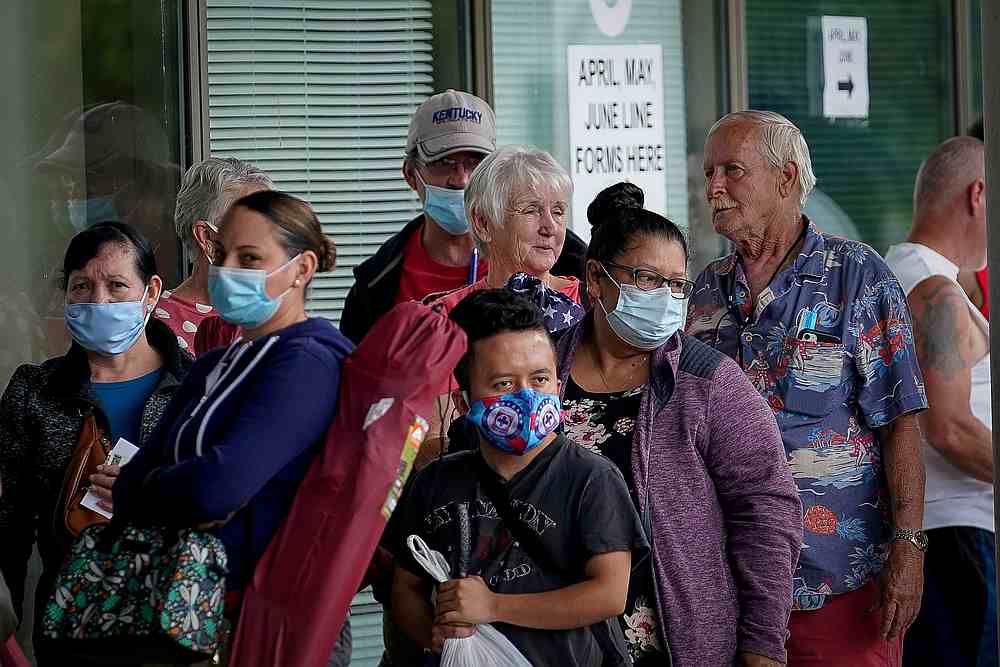
People line up outside a Kentucky Career Center hoping to find assistance with their unemployment claim in Frankfort, Kentucky June 18, 2020. — Reuters pic

WASHINGTON, Dec 30 — Jobless Americans who risked not receiving unemployment aid this week due to President Donald Trump's delay in signing off on it will indeed receive the money, the Labor Department said yesterday.

Congress in March expanded the US unemployment safety net as the coronavirus pandemic struck, creating the Pandemic Unemployment Assistance (PUA) for freelancers and Pandemic Emergency Unemployment Compensation (PEUC) for the long-term unemployed but only funding them until the end of the year.

After months of stuttering negotiations, Congress agreed to reauthorize those programs in a $900 billion spending package passed only days before their December 26 expiration, but Trump objected to its contents before eventually signing it on Sunday — one day after those programmes lapsed.

Because many states determine benefit payments for the week ahead on Sunday morning, experts feared Trump's evening signing of the bill could mean benefits under the two programs wouldn't be paid this week.

In a statement to AFP, a Labour Department spokesperson said it would work with individual states to make sure payments under the programs, which were reauthoriz

sed until March 14, continue uninterrupted.

“As states are implementing these new provisions as quickly as possible, the department does not anticipate that eligible claimants will miss a week of benefits due to the timing of the law's enactment,” the spokesperson said.

An interruption in weekly jobless payments would have increased the pressure on Americans put out of work by the world's largest Covid-19 outbreak.

The United States saw unemployment spike to 14.7 per cent in April after business shutdowns were ordered to stop the virus from spreading.

Though it decreased to 6.7 per cent in November, Labor Department data released last week said more than 800,000 people on average are losing their jobs each week, a level above the worst single week of the 2008-2010 global financial crisis.

As of the week ended December 5, the Labor Department said more than 9.2 million people were receiving PUA benefits and more than 4.8 million were receiving PEUC.

Stimulus payments

Meanwhile, American workers could start seeing stimulus payments of as much as US$600 (RM2,429) in their accounts as soon as last night, Treasury Secretary Steven Mnuchin said.

“Treasury and the IRS are working with unprecedented speed to issue a second round of Economic Impact Payments to eligible Americans and their families,” Mnuchin said.

“These payments are an integral part of our commitment to providing vital additional economic relief to the American people during this unprecedented time.”

On Twitter, he added that for those not receiving electronic payment, “paper cheques will begin to be mailed tomorrow.”

The stimulus bill set aside US$166 billion to provide cash for families to help weather the pandemic, but Trump blasted the amount and demanded it be increased to US$2,000.

Democrats agreed, and the House of Representatives approved a bill to do that, but Republican Senate Majority Leader Mitch McConnell blocked the measure, refusing to allow a vote.

“Unless Republicans have a death wish, and it is also the right thing to do, they must approve the US$2000 payments ASAP,” Trump said. “$600 IS NOT ENOUGH!” — AFP


Source: Malay Mail