30 May 2021

Success: The Insight Story – Value alignment, soft skills crucial

How has your life experience made you the leader you are today?

Having started my career at a young age, I’ve been fortunate enough to be offered the opportunity to explore various roles across sales, operations, tech, management, and regional assignments where I managed more than 20 countries. The exposure that my past experiences gave me, whether it’s learning how to roll with the punches in difficult situations or adapting to different cultural nuances across markets, played a pivotal role in shaping who I am as a leader today.

As someone who values growth in my career, I map out the milestones I want to achieve every five years using a clear performance indicator – quantity, quality and timebound. These indicators serve as a way for me to ensure that I continuously develop and demonstrate 360-degree leadership, where I strive to create a value across Trend Micro and empower my teams to deliver impactful results.

What traits do you look for in your talent or how do you decide who is right for a job?

While having a solid foundation for hard skills definitely helps someone get noticed for a job, I look out for value alignment and soft skills.

At Trend Micro, we’re dedicated to supporting diverse talent in tech. Our global education programmes, such as our Close The Gap programme – provides scholarship opportunities, financial assistance, and fundraises to advance women and the diverse workforce.

In short, I believe that well-rounded and diverse talent is key to build a sustainable and high-performing team who have the opportunity to become a trailblazer and shape the cybersecurity landscape.

How do you think the industry you are in will evolve?

With cybersecurity being an ever-evolving and high-growth industry, I believe that malicious actors will continue to find new ways to infiltrate networks for financial gain moving forward.

While some may see this trend as a never-ending mountain to climb, I see this challenge as an opportunity to collaborate with my team to build better defenses against nefarious actors. Cybersecurity companies, including Trend Micro, will increasingly work towards staying multiple steps ahead of cybercriminals to improve upon our products, including our extended detection and response technology to enable better, faster protection.

What advice can you offer those looking to start their career/own business?

Start with reflecting inwards to clearly define your passion, core competencies, weaknesses, and your potential. Then, use this as a guide to set objectives for your career. Based on the defined objective, be prepared to seek a mentor to assess the possibility on achieving it and fine-tuning it at the same time. Most importantly, those that are just getting started in their careers should employ an active-learner mindset and try their best to align their passion with their careers.

How has mentorship made a difference in your professional life?

The nature of the security industry requires us to bring in insights and experience from many schools of thought. Rather than having a dedicated mentor, I make an effort to read and listen to successful business people about the lessons they’ve picked up along the way to gain exposure on different business strategies to then adapt the values into my life and my career at Trend Micro.

What do you want to accomplish in the next five years?

My goal is to continue building a sustainable and high-performing innovative organisation at Trend Micro. Ultimately, I’d like to cultivate a strong and cohesive culture within Trend Micro, where knowledge is distributed across the team and every member of the team is self-motivated, collaborative, and employ the mindset of a lifelong learner.

Additionally, I’d like to devote more time to meaningful projects that contribute value to society, especially in terms of developing talent in the cybersecurity industry. At Trend Micro, we’re committed to providing certifications and training courses through Trainocate Malaysia, which is a Trend Micro-authorised training centre available to both novice and seasoned professionals. In the next five years, I hope to make a positive difference in addressing the talent gap here in Malaysia and across the region.

Best piece of advice you ever got on your career.

When placed in a difficult situation, make the decision that will let you sleep better at night. Often, leaders are met with complex circumstances where there are no clear-cut answers for what’s right and what’s wrong.

This piece of advice from my mother has been the rule of thumb when I have to make difficult decisions.

Most-admired business leader? Why?

I believe every successful leader has their own unique attributes, all of which I can learn from. If I had to point to just one trait, leaders who are able to emerge and learn from their failures are those that I typically admire.

How do you manage stress, challenges and mistakes that affect your career?

Stress, challenges, and mistakes are part and parcel of any career – accepting that it’s unavoidable is the first step to overcoming it. While I might not have full control of everything that happens to me or Trend Micro, what I can control is how I choose to react and move on from the situation.

Being driven and setting clear objectives for my career trajectory has helped me significantly when faced with obstacles. When stress looms or mistakes happen, I focus my attention only on reflecting on the situation, learning from it, and taking productive next steps.

A must-read for every business owner/manager is ...

The Art of War by Sun Tzu. The book outlines structured approaches in forming an effective strategy – knowing yourself, your customers, your enemies, and your terrain. It highlights that we do not need the best tools nor the best resources to win – having the right strategy trumps both.

While I’d recommend this book to any business leader, the book would be especially beneficial to small and medium businesses (SMBs), as many SMBs tend to have less access to best-of-class infrastructure, resources, financial power, and reputation when compared to larger companies. A key takeaway from this book that I’ve applied to my personal and professional life is that having the right strategy is always far more important that only having the best tools or resources in place.

What are the top three factors you would attribute your success to?

> Using both my experience and intuition for decision-making.

> Approaching life with a can-do and will-do attitude.

> Having the ability to learn and adapt to changes.


Source: The Sun Daily

British retail faces 'tsunami of closures' without rent help

A shopper wears a face mask in Old Bond Street, amid the coronavirus disease outbreak, in London, Britain, July 18, 2020. — Reuters pic

Subscribe to our Telegram channel for the latest updates on news you need to know.


LONDON, May 30 — Britain’s retail sector will endure a “tsunami of closures” if the government does not extend a moratorium on aggressive debt enforcement, industry lobby group the British Retail Consortium (BRC), said on Sunday.

Citing survey data it said two thirds of British retailers have been told by landlords they will be subject to legal measures to recover unpaid rent from July 1 when the moratorium ends.

Many UK retailers deemed “non essential” had to close their stores during multiple Covid-19 lockdowns over the last 15 months, accruing total rent debt of £2.9 billion (RM17 billion), the BRC said.

The pandemic has hammered the sector and industry data shows one in seven shops already lie empty.

The BRC’s survey found 80 per cent of tenants said some landlords have given them less than a year to pay back rent arrears.

Without action, the end of the moratorium could see thousands of shops close, said BRC chief executive Helen Dickinson.

She called on the UK government to allow the rent arrears built up during the pandemic to be ringfenced and the moratorium on repayment of these debts to be extended to the end of the year.

“With this in place, all parties can work on a sustainable long-term solution, one that shares the pain wrought by the pandemic more equally between landlords and tenants,” she said.

“Without action, it will be our city centres, our high streets and our shopping centres that suffer the consequences, holding back the wider economic recovery.” — Reuters


Source: Malay Mail

In US, tipped workers still feel the pandemic crunch

Tizoc Zarate, a demonstrator associated with One Fair Wage, an organization working to end subminimum wages. — ETX Studio pic

Subscribe to our Telegram channel for the latest updates on news you need to know.


WASHINGTON, May 30 — As the number of Covid-19 cases soared in Washington through the fall and winter, Tizoc Zarate waited tables at a local restaurant — but struggled to put enough food on the table for himself and his girlfriend.

Zarate, 22, says he is angry about the health risks he faced, especially given the low pay — and the lack of support from his bosses.

“I felt as if I couldn’t say anything to management,” Zarate told AFP, adding that at the time, he and his co-workers felt lucky to be working at all. 

The Mexican-American server is not alone — hundreds of restaurant workers and activists protested this week at lunch-hour “wage strikes” across the United States, demanding an end to what they say is unacceptable pay for tipped workers.

In the United States, restaurant and other service industry employees who earn more than a certain amount per month in tips can be paid far less than the standard minimum wage. 

With the number of diners vastly reduced due to coronavirus-related restrictions in most US cities, those workers saw their take-home salary plummet.

“During the pandemic, tips were down 60-70 per vcent and there were increased incidents of customer hostility and aggression,” says Yamila Ruiz, the communications director for One Fair Wage, which organized the protests.

“We’ve been holding strikes since last summer.”

In Washington, the “wage strike” — staged by a handful of industry workers — took place Wednesday outside the Old Ebbitt Grill, a historic bar and restaurant not far from the White House that is popular both with politicians and tourists.

“Low wages stop America’s recovery,” read one sign.

Covid-related stress on the job

Over the course of the pandemic, more than 2.5 million restaurant jobs were lost in the United States, according to the National Restaurant Association, and over 110,000 restaurants were closed. 

But now, some restaurants have said they are struggling to fill positions as businesses gradually reopen across the country, and activists say low wages are to blame.

“In January, 8 per cent of restaurant operators rated recruitment and retention of workforce as their top challenge,” National Restaurant Association Senior Vice President Hudson Riehle said. 

“By April, that number had risen to 57 per cent.”

The One Fair Wage organization surveyed restaurant workers and found that more than half reported they were considering leaving their job due to low wages.

The second most popular reason? Covid-related health risks. 

Zarate said during his drive home from his shift, he would agonize over whether he had been infected — or if somehow he had unwittingly infected someone else. 

“Probably half of the people were not wearing masks when I would come (to the table), some were not following the rule about the number of people at the table, and management would overlook things like that,” he said.

When Washington imposed tighter dining restrictions in December, the restaurant where he worked closed and Zarate was laid off. 

‘Wage shortage’

In a bid to attract employees, McDonald’s US restaurants and Chipotle Mexican Grill this month announced plans to raise wages, though McDonald’s wage increase will not pertain to franchises. 

“All restaurant sales are local,” Riehle said. “So in the end, local market forces will impact not only the increase in needed workforce, but also the particular incentives needed to recruit those employees.”

Republican critics including South Carolina congresswoman Nancy Mace blame a lack of workers in certain sectors on a supplemental US unemployment benefit of US$300 (RM1,240) a week enacted as part of President Joe Biden’s US$1.9 trillion relief package. 

Ruiz said this particular argument drove One Fair Wage to renew its protests. 

“It’s a wage shortage, not a worker shortage,” Ruiz said, refuting the idea that restaurant workers are sitting idle during pandemic layoffs by noting that many found other work.

After spending months trying — and failing — to figure out how to get unemployment benefits, Zarate finally found a new job at a pre-school.

“I got an offer this week and accepted it on Tuesday,” he said. — ETX Studio


Source: Malay Mail

UK’s Sunak says deal to be done on tax at G7, but tech must pay fair share

Britain’s Chancellor of the Exchequer Rishi Sunak attends a virtual press conference inside 10 Downing Street in central London, Britain March 3, 2021. — Reuters pic

Subscribe to our Telegram channel for the latest updates on news you need to know.


LOS ANGELES, May 30 — British finance minister Rishi Sunak said there was a deal to be done with the United States on tax but big tech firms would have to pay their fair share in return for British backing for Washington’s corporation tax proposals.

The United States has proposed a global minimum corporation tax rate of 15 per cent, well below G7 levels, but above those in some countries such as Ireland. But Britain remains concerned the plans do not go far enough on taxation of tech giants such as Amazon, Google and Facebook.

“We need them to understand why fair taxation of tech companies is important to us. There’s a deal to be had, so I’m urging the US — and all of the G7 — to come to the table next week and get it done,” Sunak told the Mail on Sunday newspaper ahead of a meeting of G7 finance ministers on June 4-5.

“Negotiations are going well ... But it has to be the right deal for Britain and that’s what this week’s negotiations will be about.”

Sunak said that firms like Facebook themselves also wanted resolution on the issue that would give them certainty and stability.

He also said that he wanted to “level the playing field for British high streets”, with Britain looking at a separate online sales tax.

“Fundamentally, the global tax system isn’t working ... Large multinational companies, particularly digital companies, are able by the nature of their businesses not to pay the right tax in the right places. And that’s not fair,” he said.

“That’s what we’re fighting hard to fix in these negotiations. If everyone works hard over the next few days and weeks, I’m confident that we can find a good place.” — Reuters


Source: Malay Mail

29 May 2021

Lazada offers free shipping, up to 48 hour delivery for groceries, essential items

Lazada will offer various vouchers for shoppers to use as they shop from the safety of home. — Lazada screenshot

Subscribe to our Telegram channel for the latest updates on news you need to know.


KUALA LUMPUR, May 29 — E-commerce platform Lazada Malaysia (Lazada) is offering a 24-to-48-hour delivery service as well as daily free shipping vouchers on essential items following the expected rise in demand for online groceries during the total lockdown.

Its chief logistics officer Olivier Petra in a statement today said during this crucial time, Lazada is prioritising the delivery fulfilment of essential items, such as fresh produce, face masks, hand sanitisers, household goods, baby supplies, and pet supplies.

“Homebound Malaysians can rest easy knowing that we will ensure their groceries are delivered fast and on time.

“We urge the local community to make use of the daily free shipping vouchers provided to shop safely from home and help curb the spread of Covid-19. We are also conducting contactless delivery for the safety and peace of mind of all our customers and staff,” he said.

Meanwhile, Lazada chief business officer Sherry Tan said grocery purchases on Lazada have tripled year on year during the nationwide Movement Control Order 3.0, and the number of local grocers that have digitalised through Lazada has nearly doubled since last year.

“We stand ready to continuously connect thousands of homegrown grocers with more than one-third of the local population shopping on the Lazada app every month,” she added.

Online shoppers can have easy access to fresh vegetables, fruits, meat, seafood, cooking ingredients, and daily essentials from thousands of local grocers specially curated on the ‘Shop From Home’ page via http://lzd.co/MalaysiaShopFromHome.

Online shoppers can select stores on the page for same-day, next-day, and 48-hour deliveries in Klang Valley and enjoy millions of free shipping vouchers that are restocked on a daily basis at midnight. — Bernama


Source: Malay Mail

FBM KLCI likely to move in 1,580-1,600 range next week

KUALA LUMPUR: The key index of Bursa Malaysia is expected to hover between 1,580 and 1,600 next week, as sentiment continued to be clouded by the surging Covid-19 cases in the country.

Rakuten Trade Sdn Bhd head of equity sales Vincent Lau said investor sentiment remained fragile as the rising cases had sparked fears of another full lockdown among market players.

“Without the lockdown woes, the barometer index is likely to breach the next resistance level of 1,600.

“But given the current situation whereby the new Covid-19 cases crossed 8,000 cases on Friday, the market barometer is likely to move between 1,580 and 1,600 next week,” he told Bernama.

He anticipated that traders might look to buy on weakness should the stocks retreat significantly next week.

Meanwhile, both Lau and Areca Capital Sdn Bhd chief executive officer Danny Wong shared a similar view that recovery-themed sectors such as technology, glove and healthcare might stage a comeback next week.

Health director-general Tan Sri Dr Noor Hisham Abdullah tweeted on Friday that Malaysia reported a record 8,290 new Covid-19 cases over the past 24 hours, bringing the total number of cases in the country to-date to 549,514.

Following the spike in new infections, the Prime Minister’s Office issued a statement late Friday that the special session of the National Security Council (MKN) on Covid-19 management had decided to implement a total lockdown on the social and economic sectors (first phase) nationwide from June 1 to June 14.

According to the statement, throughout this period all sectors will not be allowed to operate, except for essential economic and service sectors to be listed by MKN.

The government will also implement a second phase lockdown that will allow the reopening of some economic sectors that do not involve large gatherings and can comply with physical distancing, if the first phase succeeds in reducing Covid-19 daily cases.

“This second phase will be enforced for a period of four weeks after the first phase ends,” it said.

For the week just ended, the FTSE Bursa Malaysia KLCI (FBM KLCI) expanded 32.27 points to 1,594.44 from 1,562.17 registered on Friday of the previous week.

During the holiday-shortened trading week, the market hit intra-day high on three consecutive days as solid corporate earnings for the quarter ended March 31, 2021, eclipsed jitters caused by the tightened Movement Control Order 3.0 announcement made last Saturday.

However, gains in the market were capped by concerns over the rising Covid-19 cases after the country reported several fresh highs of infections over the past week, with the highest number touching 8,290 cases on Friday.

The local bourse was closed on Wednesday for the Wesak Day celebration.

On the index board, the FBM Emas Index was 242.47 points higher at 11,578.50, the FBMT 100 Index leapt 234.38 points to 11,276.60, the FBM Emas Shariah Index jumped 239.01 points to 12,847.04, the FBM 70 strengthened 332.99 points to 14.869.65, and the FBM ACE was 219.01 points firmer at 7,843.88.

Sector-wise, the Financial Services Index surged 399.13 points to 15,167.13, the Plantation Index gained 8.94 points to 6,908.46, and the Industrial Products and Services Index added 5.79 points to 193.09.

The Energy Index perked 17.68 points to 863.60, the Technology Index lifted 3.47 points to 78.98, and the Healthcare Index bagged 2.69 points to 3,134.39.

Weekly turnover eased to 30.51 billion units worth RM18.84 billion against 32.44 billion units worth RM16.52 billion in the previous week.

Main Market volume narrowed to 16.84 billion shares valued at RM14.96 billion versus 18.69 billion shares valued at RM15.29 billion last week.

Warrants volume declined to 944.87 million units worth RM104.14 million compared with 1.53 billion units worth RM152.39 million previously.

The ACE Market volume went up to 12.71 billion shares valued at RM3.75 billion from 12.24 billion shares valued at RM4.21 billion in the preceding week.- Bernama


Source: The Sun Daily

Ringgit to continue upward momentum next week

Malay Mail Social Logo

KUALA LUMPUR, May 29 — The ringgit is likely to continue its positive momentum against the US dollar next week, amid the continued weakness of the greenback on the back of various developments in the market which is affecting the currency, said an analyst.

ActivTrades trader Dyogenes Rodrigues Diniz said the US dollar had been falling against the ringgit due to mixed economic data from the United States.

“On the one hand, the number of initial jobless claims came in lower than expected, which is usually bullish for the US dollar, and much-weaker-than-expected pending home sales data put the greenback under pressure.

“US gross domestic product data (for the first quarter), roughly in line with expectations, failed to clear investors’ doubts over the US economic recovery,” he said.

He said this led to a sell-off of the US dollar while investors bought more equities on the back of expectations that economic stimulus would last a while longer.

“Hence, the ringgit is expected to trade up to the 4.1000 mark against the US dollar next week,” he added.

Meanwhile, another analyst said the steady oil price, with international benchmark Brent crude oil now above US$69 per barrel, would also benefit the ringgit’s performance.

He said if oil price rise were to continue up to US$70 per barrel, not only the ringgit but also other currencies would get a boost, with oil being one of the country’s sources of revenue.

On the local front, a special session of the National Security Council (MKN) on Covid-19 management has decided to implement a total lockdown on the social and economic sectors (first phase) nationwide for 14 days beginning June 1.

In a statement on Friday, the Prime Minister’s Office said throughout this period, all sectors would not be allowed to operate except for essential economic and service sectors to be listed by MKN.

It said the decision was reached after taking into account the latest Covid-19 situation in Malaysia, with daily cases exceeding 8,000 and over 70,000 active cases.

On a weekly basis, the ringgit appreciated versus the US dollar to 4.1320/1350 from 4.1390/1430 a week earlier.

The local note was mostly higher against other major currencies.

It strengthened against the yen to 3.7598/7629 from 3.8074/8118 a week earlier, increased versus the British pound to 5.8604/8651 from 5.8832/8897 and rose against the euro to 5.0344/0385 from 5.0595/0656.

The ringgit, however, dipped against the Singapore dollar to 3.1213/1238 from 3.1099/1141 in the preceding week. — Bernama


Source: Malay Mail

FBM KLCI likely to move in 1,580-1,600 range next week; recovery-themed stocks to stage comeback

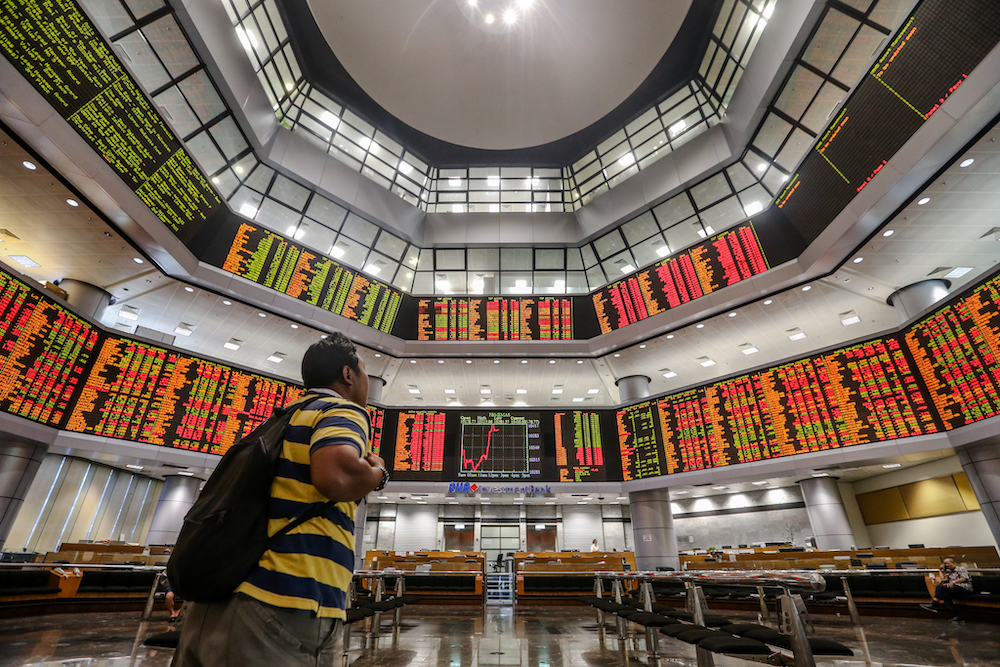
During the holiday-shortened trading week, the market hit intra-day high on three consecutive days as solid corporate earnings for the quarter ended March 31, 2021, eclipsed jitters caused by the tightened movement control order 3.0 announcement made last Saturday. — Picture by Firdaus Latif

Subscribe to our Telegram channel for the latest updates on news you need to know.


KUALA LUMPUR, May 29 — The key index of Bursa Malaysia is expected to hover between 1,580 and 1,600 next week, as sentiment continued to be clouded by the surging Covid-19 cases in the country.

Rakuten Trade Sdn Bhd head of equity sales Vincent Lau said investor sentiment remained fragile as the rising cases had sparked fears of another full lockdown among market players.

“Without the lockdown woes, the barometre index is likely to breach the next resistance level of 1,600.

“But given the current situation whereby the new Covid-19 cases crossed 8,000 cases yesterday, the market barometre is likely to move between 1,580 and 1,600 next week,” he told Bernama.

He anticipated that traders might look to buy on weakness should the stocks retreat significantly next week.

Meanwhile, both Lau and Areca Capital Sdn Bhd chief executive officer Danny Wong shared a similar view that recovery-themed sectors such as technology, glove and healthcare might stage a comeback next week.

Health director-general Tan Sri Dr Noor Hisham Abdullah tweeted yesterday that Malaysia reported a record 8,290 new Covid-19 cases over the past 24 hours, bringing the total number of cases in the country to-date to 549,514.

Following the spike in new infections, the Prime Minister’s Office issued a statement late yesterday that the special session of the National Security Council (MKN) on Covid-19 management had decided to implement a total lockdown on the social and economic sectors (first phase) nationwide from June 1 to June 14.

According to the statement, throughout this period all sectors will not be allowed to operate, except for essential economic and service sectors to be listed by MKN.

The government will also implement a second phase lockdown that will allow the reopening of some economic sectors that do not involve large gatherings and can comply with physical distancing, if the first phase succeeds in reducing Covid-19 daily cases.

“This second phase will be enforced for a period of four weeks after the first phase ends,” it said.

For the week just ended, the FTSE Bursa Malaysia KLCI (FBM KLCI) expanded 32.27 points to 1,594.44 from 1,562.17 registered yesterday of the previous week.

During the holiday-shortened trading week, the market hit intra-day high on three consecutive days as solid corporate earnings for the quarter ended March 31, 2021, eclipsed jitters caused by the tightened movement control order 3.0 announcement made last Saturday.

However, gains in the market were capped by concerns over the rising Covid-19 cases after the country reported several fresh highs of infections over the past week, with the highest number touching 8,290 cases yesterday.

The local bourse was closed on Wednesday for the Wesak Day celebration.

On the index board, the FBM Emas Index was 242.47 points higher at 11,578.50, the FBMT 100 Index leapt 234.38 points to 11,276.60, the FBM Emas Shariah Index jumped 239.01 points to 12,847.04, the FBM 70 strengthened 332.99 points to 14.869.65, and the FBM ACE was 219.01 points firmer at 7,843.88.

Sector-wise, the Financial Services Index surged 399.13 points to 15,167.13, the Plantation Index gained 8.94 points to 6,908.46, and the Industrial Products and Services Index added 5.79 points to 193.09.

The Energy Index perked 17.68 points to 863.60, the Technology Index lifted 3.47 points to 78.98, and the Healthcare Index bagged 2.69 points to 3,134.39.

Weekly turnover eased to 30.51 billion units worth RM18.84 billion against 32.44 billion units worth RM16.52 billion in the previous week.

Main Market volume narrowed to 16.84 billion shares valued at RM14.96 billion versus 18.69 billion shares valued at RM15.29 billion last week.

Warrants volume declined to 944.87 million units worth RM104.14 million compared with 1.53 billion units worth RM152.39 million previously.

The ACE Market volume went up to 12.71 billion shares valued at RM3.75 billion from 12.24 billion shares valued at RM4.21 billion in the preceding week. ­— Bernama


Source: Malay Mail

Dollar gives up gains for week as markets digest economic data

The dollar index of major currencies rose as much as 0.4 per cent during the day in a sharp rebound from 4-1/2 month lows plumbed on Tuesday before it fell back to flat for the day and the week at 89.99. — Reuters pic

Subscribe to our Telegram channel for the latest updates on news you need to know.


NEW YORK, May 29 — The dollar gave up gains from early yesterday as traders tidied positions ahead of month-end and a holiday weekend after seeing new economic data confirm expectations about US inflation and the recovery from the Covid-19 pandemic.

The dollar index of major currencies rose as much as 0.4 per cent during the day in a sharp rebound from 4-1/2 month lows plumbed on Tuesday before it fell back to flat for the day and the week at 89.99.

Ending with little change was a break from the down trend since March that had taken 3 per cent from the dollar’s value as other major economies began to catch up with vaccination rates in the United States.

At the same time, central banks in some other countries had appeared likely to move more quickly than the US Federal Reserve to back away from easy money policies and let interest rates rise.

The euro was up a bare 0.05 per cent at US$1.22 (RM5.04) on Friday afternoon, compared with a four-month high of US$1.2266 earlier in the week.

The British pound was flat at US$1.4199, continuing its recent struggle to stay above US$1.42.

On Monday, the United States and Britain have public holidays.

The US economic data had been seen as the big scheduled news of the week, but it did not move bond and stock markets much when it was released in the morning.

The data showed that consumer prices increased in April far beyond the Federal Reserve’s 2 per cent annual rate target.

The inflation readings had been widely anticipated and were not expected to have an impact on policy from the Fed, which has viewed recent price increases as adjustments for the reopening of the economy.

The next big event for the markets is the Fed’s monetary policy meeting on June 15 and 16, which could provide clues to when US interest rates will increase.

Fed officials could show projections for stronger economic growth. That would point toward the central bank tapering its purchases of bonds and allowing longer-term interest rates to rise, which would support the dollar, said Joseph Trevisani, senior analyst at FXStreet.com.

“The Fed is trying to prepare the markets for the inevitability of tapering,” Trevisani said.

The major currency that would most likely lose against the dollar is the Japanese yen, Trevisani said, citing trouble with Japan’s recovery from the pandemic compared with Europe and Britain.

The dollar gained against the yen early yesterday and hit a seven-week high before easing to show little change on the day.

The dollar last traded around ¥109.77 after reaching as high as 110.2.

Japan has seen a rise in unemployment, falling consumer prices and government moves to extend emergency restrictions in Tokyo and other areas because of the Covid-19 pandemic.

China’s onshore yuan appreciated to as few as 6.358 per dollar, a new three-year high.

The dollar was last trading at 6.3616 yuan, down 0.15 per cent for the day.

Kenneth Broux, FX strategist at Societe Generale, said the fact that the yuan has been stronger than 6.40 for three days could be a turning point in Chinese policy that would be positive for the global economy.

“Nobody thought that the central bank would allow the yuan to strengthen beyond 6.40, and they have,” Broux added.

The New Zealand dollar, which this week had jumped on the prospect of an interest rate hike by September 2022, fell as much as 1 per cent against the greenback early in the day.

In cryptocurrencies, bitcoin was down about 6 per cent at US$36,174 in the morning in New York, while ether was down 8 per cent at around US$2,510. — Reuters


Source: Malay Mail